
It also provides outpatient diagnostic services and consultations for the clinic’s internal veterinarians. Thanks to our team of veterinarians, state-of-the-art instruments and equipment in the new intensive care unit, TAH Veterinary Clinic aims to be a leading centre in the Canton of Ticino.
- Management of cardiac emergencies: our intensive and intermediate care units are equipped to accommodate all types of patients and provide continuous care 24 hours a day.
- Diagnosis of heart disease: this examination should be prescribed whenever the veterinarian detects a heart murmur during cardiac auscultation, in both young and elderly animals. Symptoms that should not be overlooked and for which an echocardiographic examination is always recommended include coughing, episodes of syncope, weakness and fatigue.
- Health plans: these make it possible to monitor the cardiac condition year after year and establish effective treatment in the early stages of the disease, when the typical symptoms of this insidious condition are not yet present, in order to ensure a long and healthy life expectancy. Echocardiography is indicated for dogs and cats of certain predisposed breeds and can be included in your health plan at a favourable price.
What is an echocardiogram?
Echocardiography is a technique that uses ultrasound to obtain information about the contractility of the heart, the great vessels, the morphology of the heart valves and the flow of blood through them. Unlike the radiation used in radiology, ultrasound is harmless, so no precautions are necessary and the examination can be performed on any patient countless times.
Echocardiography is neither painful nor dangerous.
Who can undergo echocardiography?
There are no particular contraindications to echocardiography: any patient can undergo the examination.
Preparation instructions
- medical treatment: morning medication may be administered with a little water; only medications indicated by the attending veterinarian must be discontinued
- fasting for 8 hours is required (a little water is permitted) in case blood tests are necessary to complete the examination
- all previous cardiac medical documentation must be brought to the appointment
Is transthoracic echocardiography painful or dangerous?
Transthoracic echocardiography is neither invasive nor painful and allows the patient to resume their normal routine immediately after the examination.
Holter ECG (Holter ambulatory electrocardiogram)
A Holter ECG is a diagnostic examination that allows the electrical activity of the heart to be recorded continuously over a period of 24 hours. A Holter ECG is requested to:
- Assess the heart rhythm and therefore check for the possible presence of cardiac arrhythmias, their type, their exact number and their distribution over the 24-hour recording period, providing the cardiologist with precise and extremely useful data for evaluating any measures that may need to be taken.
These arrhythmias may also occur in patients whose hearts are perfectly “healthy” from an anatomical and functional point of view. In practice, a standard electrocardiogram followed by a colour Doppler echocardiogram, both with negative results, does not exclude the presence of arrhythmias.
The Holter ECG examination is also prescribed for patients receiving medication for arrhythmias, making it possible to accurately assess the effectiveness of treatment throughout the day.- Further diagnostic investigation: this examination is also useful for non-cardiac conditions or conditions of uncertain cardiac origin.
- Indicated in all cases of loss of consciousness, “fainting” or “falls”, which may also have an arrhythmic origin and consequently require this examination.
How the examination is performed
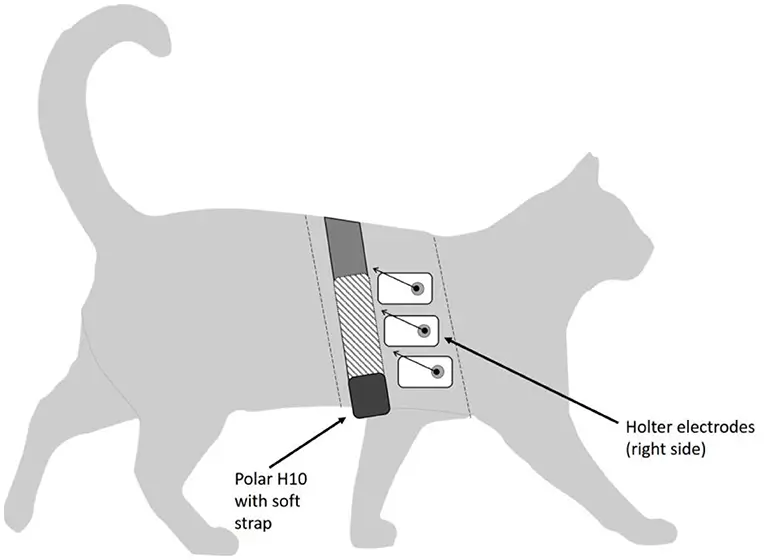
The equipment available at TAH Veterinary Clinic is of the latest generation, lightweight, easy to apply and extremely reliable.
Electrodes are attached to the patient’s chest and then connected to a small battery-powered device secured with a body garment. Mobility remains excellent, and the patient should continue their normal daily activities, taking care only to avoid getting the equipment wet, accidentally knocking it or removing the electrodes from the chest.
The owner is then asked to complete a diary summarising the events of the day (waking up, falling asleep, meals, medication intake, symptoms, main daily activities or particular events) and, after the scheduled recording period, returns to our Centre to have the equipment removed.
The cardiologist will then personally review the recording (no automatic computerised interpretation is performed) and prepare a detailed report within a short period of time.![holter ECG animali]()